Renewable Energy Micro-Enterprises: Solar, Biogas, and Mini-Grids

Sumita Singh
August 12, 2026
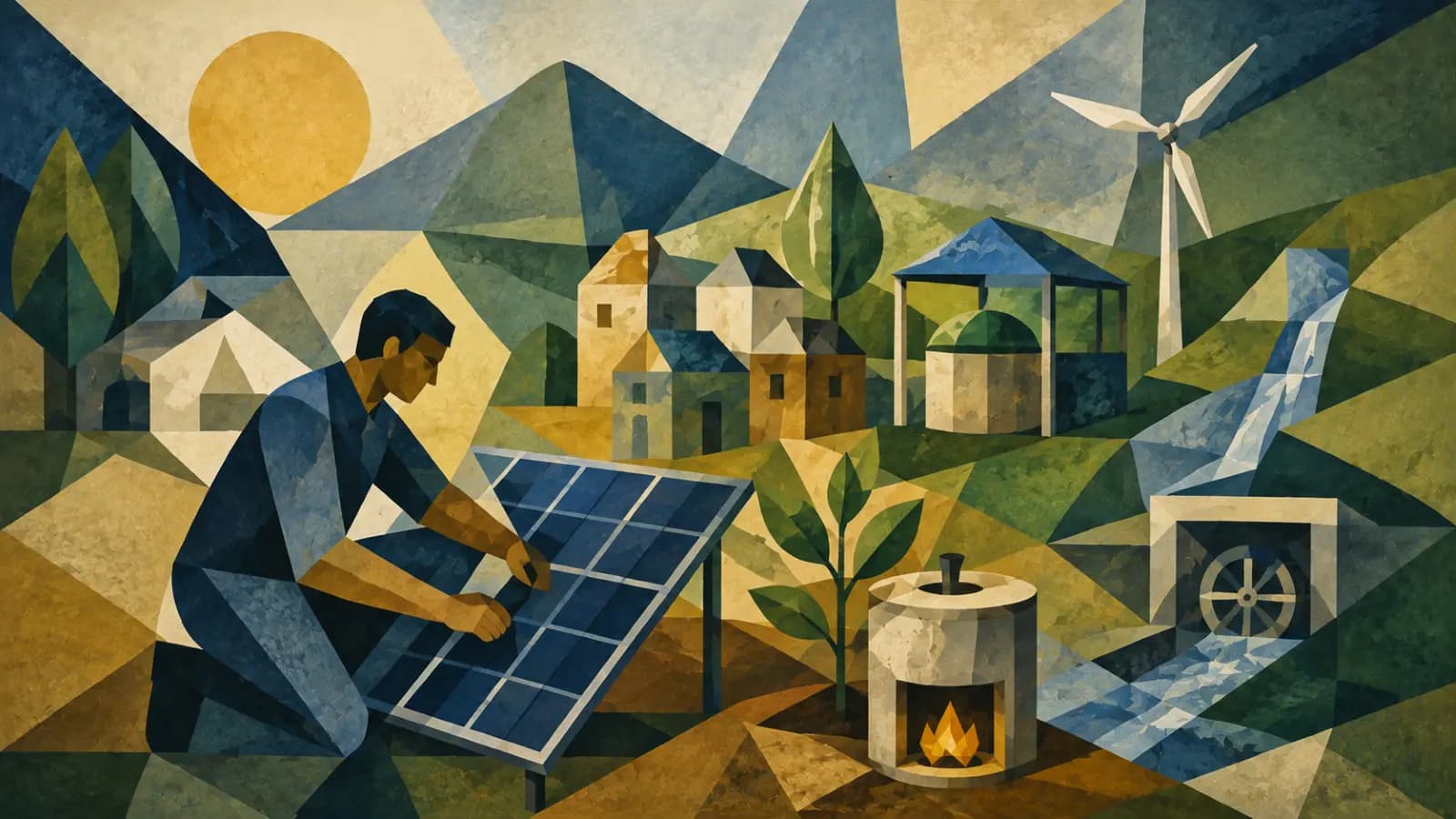
Ask someone to picture a renewable energy company, and they’ll likely imagine a wind farm on the horizon or a solar park the size of a small town – not a two-person shop that sells lanterns on instalment and fixes the occasional biogas plant on the side. That gap between the image and the reality is, in many ways, the whole story of clean energy access in South Asia.
This is the world of renewable energy micro-enterprises, and it’s a category that rarely gets the spotlight it deserves.
What Is Renewable Energy Micro-Enterprises?
A renewable energy micro-enterprise is a small, often locally owned business that installs, sells, services, or finances clean energy solutions for households, farms, or small commercial users – at a scale far below utility or industrial projects. These are small teams – often fewer than a dozen people – serving a village or district, not a state, for customers who are new to energy access or moving away from diesel, kerosene, and firewood.
What makes these enterprises distinctive is their proximity to the customer. They understand hyper-local energy needs: a farmer who needs three hours of irrigation before the market opens, a household that can’t afford an upfront solar system but can manage a monthly fee, a poultry farm that produces enough waste to power its own kitchen. Micro-enterprises fill exactly these gaps, in places where large developers see too little margin to bother.
Types of Renewable Energy Micro-Enterprises: Solar, Biogas, and Beyond
This isn’t a single business model, it’s an entire ecosystem of small, interlocking trades:
Solar Energy Installers: Local companies that design and install rooftop solar systems for homes, shops, and farms, usually starting with small residential or commercial loads before scaling into larger installations.
Solar Irrigation Providers: Enterprises that supply and maintain solar-powered water pumps, replacing diesel pump sets for farmers and cutting both fuel costs and emissions during the growing season. The scale of this shift is already visible in India, where the government’s PM-KUSUM programme had enabled over 1.09 million standalone solar irrigation pumps by November 2025, as reported to the Lok Sabha – each one installed, and in most cases serviced, by a local vendor rather than a national utility.

Solar Appliance Retailers: Businesses selling or leasing solar lanterns, solar dryers, solar-powered refrigeration units, and similar devices – often the first point of contact between rural households and clean energy.
Biogas Enterprises: Small operators who install and maintain biogas plants for households and farms, converting cattle dung and organic waste into cooking fuel and organic manure.
Biomass Processors: Businesses that turn agricultural residue – straw, husks, stalks – into briquettes, pellets, or fuel, tackling both crop-waste burning and energy access in one move.
Small & Micro-Hydropower Operators: Community-run or cooperative businesses that harness local streams and rivers for small-scale hydropower, particularly common in hilly and mountainous parts of South Asia.
Energy-as-a-Service Providers: Companies offering “solar-as-a-service” or pay-per-use clean energy models, where customers pay for power consumed rather than owning the equipment outright.
Installation & Maintenance Technicians: The often-overlooked backbone of the renewable energy sector: local technicians and small firms who install, repair, and service renewable energy systems long after the big installer has moved on.
Clean-energy Financing Enterprises: Small players offering leasing or pay-as-you-go financing for solar equipment, making upfront-cost barriers disappear for low-income customers.
Each of these plays a different role, but they share a common thread: they turn renewable energy from a policy goal into something a household or small business can actually use, afford, and maintain.
Why Renewable Energy Micro-Enterprises Matter for South Asia’s Energy Access
South Asia doesn’t have one energy story; it has millions of small, local ones.
Hundreds of millions of people live in villages, small towns, and dispersed rural clusters where extending or reinforcing the central grid is either technically difficult or economically unviable. At the same time, the region carries a disproportionate share of climate vulnerability – from erratic monsoons to extreme heat – which turns the shift away from diesel, kerosene, and biomass burning into a matter of resilience as much as environmental policy.
Renewable energy micro-enterprises are how that shift actually happens on the ground. They create local jobs – as installers, technicians, and sales agents – often in places with few other formal employment options. And they keep money circulating within local economies rather than flowing to distant utilities or fuel importers, building a layer of local technical capacity and entrepreneurship that a single large project simply can’t replicate.
“Clean energy isn’t reaching South Asia’s villages through gigawatt announcements; it’s arriving one solar pump, one biogas plant, one local technician at a time.”
Nowhere is this more visible than in mini-grids – small, self-contained power systems that serve a village or cluster of villages independent of the main grid.
The World Bank’s Energy Sector Management Assistance Program (ESMAP) tracks roughly 11,000 installed mini-grids across Africa and South Asia combined, representing about $5 billion in investment and serving an estimated 31 million people – with Afghanistan, India, and Nepal among the countries with the highest number of mini-grid installations in Asia as detailed in the World Bank’s report, “Mini Grids for Half a Billion People”. Very few of these are built or run by large utilities. In practice, ownership sits with independent developers, rural cooperatives, and increasingly, community-owned entities.

But growth isn’t the whole story. Global sales of off-grid solar energy kits crossed 10 million units for the first time in 2025, as per GOGLA, Global Off-Grid Solar Market Report – but GOGLA’s own data shows South Asia has been a structural exception, with demand for basic solar lighting products declining over the past several years as grid electrification expands into areas that once relied on off-grid solar.
That’s not necessarily bad news for the sector: it suggests successful micro-enterprises in the region need to evolve past basic lighting and lanterns into irrigation, appliances, and financing services – the categories where the region’s runway is still long – rather than assuming static demand for entry-level products.
The Financing Gap Facing Clean Energy Micro-Enterprises in South Asia
Despite their impact, renewable energy micro-enterprises sit in an awkward financing gap. They’re too small and too “unbankable” by conventional standards to attract the large-ticket climate finance flowing into utility-scale renewables or major clean-tech ventures. At the same time, they’re often too commercially structured – and too growth-oriented – to fit neatly into traditional microfinance or NGO grant models designed for subsistence livelihoods.
“Too big for microfinance, too small for climate funds, South Asia’s clean energy micro-enterprises are falling through the cracks of their own success.”
Practitioners in the energy access sector have a name for this: the “missing middle.” Operators who work across distributed renewable energy markets estimate that meeting 2030 electrification targets will require around $35 trillion a year in investment – yet available capital tends to sit at the two extremes of the risk spectrum: concessional grants and subsidies for early-stage pilots, and commercial debt for companies that have already reached scale.
Enterprises in between – past the pilot stage, but without the audited financials or collateral commercial lenders expect – are left to navigate the gap alone: too informal for conventional lenders, and past the point where grant funding typically follows up. The result is models that have already proven themselves staying small – capped not by demand, but by capital.
The Way Forward: Financing Solutions for Renewable Energy Micro-Enterprises
Closing this gap doesn’t require inventing new financial instruments – models already exist, they’re just under-deployed at the scale South Asia’s micro-enterprises need. Blended finance facilities that pair concessional capital with commercial investment are one route: Convergence, the blended finance network, has backed the design of a facility aimed specifically at distributed renewable energy developers across South and Southeast Asia, targeting roughly $180 million to unlock financing for projects that fall outside conventional lenders’ risk appetite.
Credit structures also need to match how these enterprises actually earn revenue. For South Asia’s mini-grid operators specifically, analysts at the Institute for Energy Economics and Financial Analysis (IEEFA) point to revenue shortfall guarantees – blended with concessional and market-rate debt and a developer’s own equity – as a way to de-risk projects for lenders without demanding the collateral a small, asset-light operator simply doesn’t have.
What’s missing isn’t the mechanism – it’s reach. These instruments exist in only a handful of pilot facilities; scaling them and letting a workable model in one country inform another – a solar irrigation scheme in India shaping a biogas credit line in Nepal – is the unglamorous work still ahead.
None of this will make headlines the way a gigawatt-scale solar park does. But in aggregate, it may be doing more to bring reliable, clean power to South Asia’s underserved communities than any single large project could. Recognizing these micro-enterprises – and financing them properly – deserves a central place in the region’s climate transition.
Join SAFFAL
The Climate Finance Catalyst for South Asia
Apply as an Impact Philanthropist, Donor, Startup, SME, Climate Expert, or Institution. Mobilize climate capital into the right sectors.