For impact investors and DFIs
A pipeline of accelerator-graduated climate SMEs. Structured for deployment.
SAFFAL gives impact investors and DFIs access to vetted, investment-ready SMEs across South Asia - with blended structures that de-risk entry, concessional capital that absorbs first-loss, and co-investment alongside a community of peer deployers. Y Combinator meets AngelList - purpose-built for climate SMEs and blended capital.
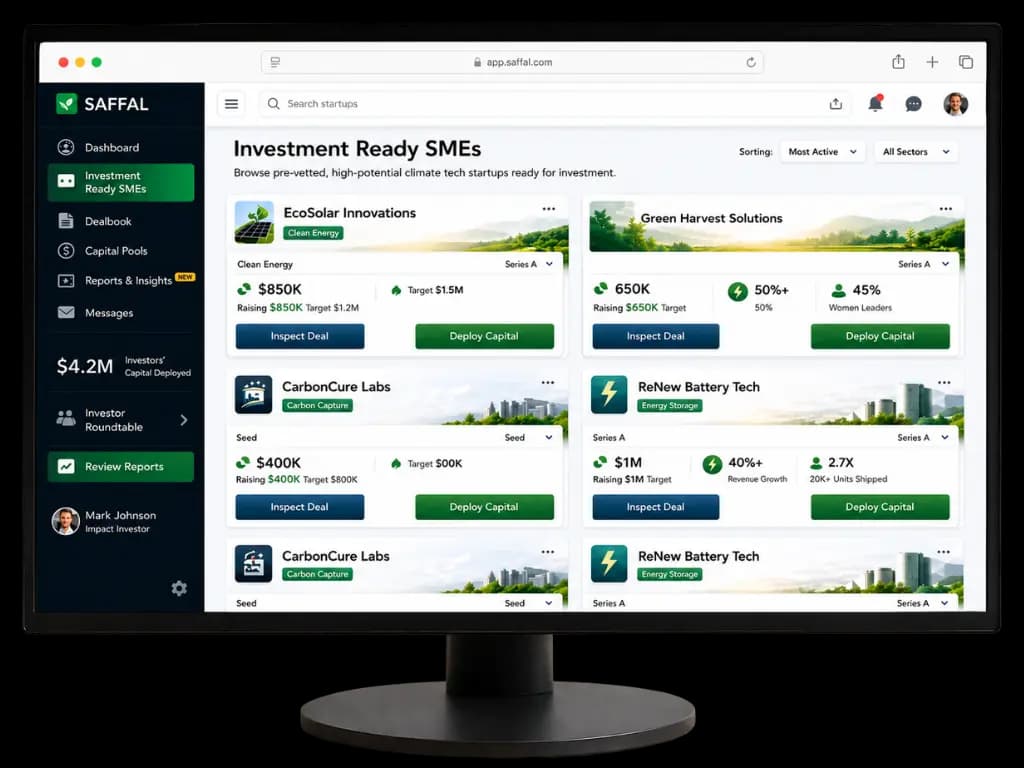
The Pipeline Problem
You have the capital. The pipeline is the problem.
Every impact investor and DFI deploying into South Asia has the same constraint: not capital, but pipeline. The climate SMEs that need investment are too small for standard DFI ticket sizes, too early for commercial equity, and too unstructured for most impact funds to underwrite directly. Origination costs are high, diligence is expensive, and the concessional layer needed to de-risk entry often doesn't exist.
Most platforms addressing this gap are directories. They aggregate deals but do no work on them. The SME you find in a directory is the same SME you could have found yourself - just slightly easier to discover.
SAFFAL is different. Every SME in the pipeline has been through an accelerator. Every deal has a structured capital stack. Every deployment has a concessional layer already in place, underwritten by philanthropic and catalytic partners. You walk into a ready-to-close deal, not a lead.
Why Impact Investors & DFIs Partner With SAFFAL
Four things investors get from SAFFAL that direct origination doesn't provide.
01
Accelerator-graduated pipeline
Every SME has been through SAFFAL's structured bootcamp - governance, financials, capital stack, and impact metrics are already in place. Pipeline is vetted, graded, and clustered by sector and capital readiness. Your origination and diligence costs drop materially.
02
Pre-structured blended stacks
Catalytic capital absorbs first-loss. Grant funding underwrites the accelerator and technical assistance layer. Your equity or debt sits in the senior tranche, with a risk profile actually consistent with your mandate. The concessional layer is already in place when you arrive.
03
Co-investment with peer deployers
Deploy alongside a curated community of DFIs, impact funds, family offices, and catalytic philanthropies. Shared diligence, shared deal terms, shared governance. Syndication is built into the platform - not negotiated deal-by-deal.
04
Portfolio-grade impact monitoring
Continuous, independent monitoring across the portfolio - aligned with IRIS+ and the Operating Principles for Impact Management. Impact data flows directly to your reporting systems. No bespoke measurement frameworks, no self-reported metrics.
How SAFFAL Originates, Accelerates, and Structures
The three-engine model: Accelerate, Structure, Monitor.
SAFFAL runs three integrated engines. Think of it as Y Combinator meets AngelList - purpose-built for climate SMEs and blended capital.
The YC Side
Accelerate
Structured bootcamp across governance, financial operations, capital stack design, impact measurement, and investment readiness. Cohort-based, sector-clustered. Demo day to institutional capital partners at graduation.
Investor outcome: SMEs arrive with clean data rooms, investor-grade financials, and realistic capital asks.
The AngelList Side
Structure
Capital stack design - first-loss tranche, concessional layer, senior tranche - structured per deployment. Entity setup, documentation, regulatory compliance handled by SAFFAL. Investors deploy through shared, standardised infrastructure.
Investor outcome: syndicated terms, standardised docs, no bespoke vehicle per deal.
The SAFFAL Addition
Monitor
Continuous portfolio monitoring - financial performance, impact metrics, ESG and safeguarding. Independent, not self-reported. Aligned with IRIS+ and Operating Principles for Impact Management.
Investor outcome: board-ready impact and performance reporting, delivered quarterly.
Deployment Structures
How investors deploy capital through SAFFAL.
Capital deployment through SAFFAL happens in one of four structures. Each is designed to fit different investor mandates, ticket sizes, and risk-return profiles. Investors can participate in one structure or across multiple.
Direct co-investment
Deploy directly into a single SME alongside the concessional tranche and peer co-investors, using SAFFAL's standardised deal documentation. Best suited to impact funds and DFIs with existing direct-deal capability. Typical tickets: $[X] - $[X]M.
Portfolio participation
Deploy across a curated basket of SMEs within a sector or geographic cluster - for example, clean energy across India, Bangladesh and Sri Lanka; or sustainable agri across South Asia. Diversified exposure, managed by SAFFAL. Best suited to impact funds, family offices, and DFI thematic windows.
Thematic facility
Co-created with an anchor investor or group of investors - a gender-lens facility, a low-carbon mobility facility, a country-focused facility - structured with SAFFAL and governed jointly. Best suited to DFIs and large impact funds with specific thematic mandates.
Fund-level participation
Participate as an LP in the SAFFAL Phase 2 fund structure, currently being established in Singapore. Offers diversified exposure across the entire SAFFAL pipeline, with institutional governance and standardised reporting. Best suited to DFIs, institutional impact investors, and larger family offices.
Pipeline Composition
What the pipeline looks like.
SAFFAL's pipeline spans the climate economy sectors where South Asian SMEs are structurally underfunded but commercially viable. Below is the current sectoral breakdown as of Phase 2 onboarding.
| Sector | Sub-sectors | Typical ticket | Capital structures |
|---|---|---|---|
| Clean Energy | Distributed solar, mini-grids, clean cooking, efficiency | $[X] - $[X]M | Debt, equity, blended |
| Sustainable Agri | Climate-resilient farming, agri supply-chain, food systems | $[X] - $[X]M | Debt, equity, blended |
| Low-Carbon Mobility | Electric mobility, fleet electrification, charging infrastructure | $[X] - $[X]M | Debt, equity, blended |
| Waste & Circular | Plastic circularity, waste processing, material recovery | $[X] - $[X]M | Debt, equity, blended |
| Low-Carbon Tech | Carbon measurement, climate adaptation tech, cleantech IP | $[X] - $[X]M | Equity, blended |
Geographic coverage
Active pipeline across India, Bangladesh, Sri Lanka, Nepal, and Pakistan, with selective coverage in the Maldives and Bhutan. Phase 2 expansion targets deeper coverage within India's tier-2 and tier-3 markets, where the climate SME financing gap is most acute.
Live pipeline access
SAFFAL members access live pipeline data through a gated investor dashboard - updated continuously, with SME-level diligence materials available under NDA. Access is granted after membership approval.
Governance, Compliance & Standards
Built for the scrutiny institutional capital requires.
SAFFAL operates under institutional-grade governance with specific alignment to DFI and impact-investor standards. Every deployment passes through structured committee review, independent impact measurement, and ongoing audit.
Governance structure
- Investment Committee - reviews and approves all deployments under defined underwriting criteria.
- SAFFAL Steering Committee - includes anchor investors, DFIs, donors, and institutional partners.
- Risk & Compliance Committee - oversees operational risk, regulatory compliance, AML and KYC.
- Advisory Board - senior sector and development finance experts.
Standards alignment
- Impact measurement aligned with IRIS+.
- Signatory to the Operating Principles for Impact Management.
- Environmental and Social Management System (ESMS) applied to every deployment.
- Gender lens applied per partnership with UN Women; 2X Challenge aligned where applicable.
- Reporting structured to meet OECD DAC norms for DFI participants.
Fund and entity structure
- SAFFAL Phase 2 fund being domiciled in Singapore under Monetary Authority of Singapore (MAS) oversight.
- Separation between grant-funded platform operations and capital deployment activities, audited independently.
- Annual independent audit of financial statements, available to members on request.
Who's in the Room
Deploying alongside peer institutions.
SAFFAL was launched with UNEP and UN Women, is anchored by the Massive Earth Foundation, and is joined by a curated community of DFIs, impact funds, family offices, and catalytic partners.


.jpg&w=3840&q=75)
Apply for membership.
If your institution is ready to deploy into South Asia's climate SMEs - through direct co-investment, portfolio participation, thematic facilities, or fund-level participation - SAFFAL membership is by application.
FAQ